Thursday May 21, 2026
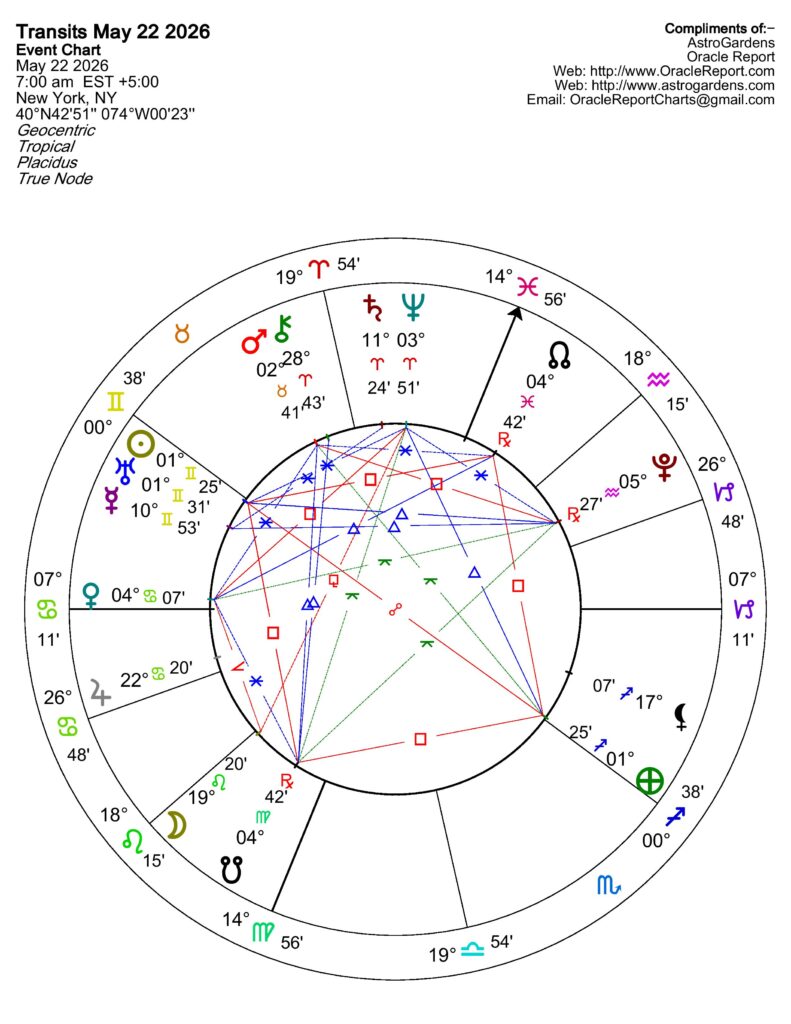
– Crescent Moon Phase – begin, initiate, wish, project, set an intention
– Moon in LEO – Void of Course 6:06 PM – 5/23 2:57 AM PM Moving to VIRGO
– Retrogrades –
- PLUTO – May 6 to Oct 15 – This period brings intense inner reflection, shifting the focus from external societal changes to internal transformation, forcing us to confront power dynamics, subconscious patterns, and personal evolution
– Best Days (from the Farmer’s Almanac) – May 21st – 22nd – Cut Firewood, Mow to Increase Growth, Dig Holes, Paint, Get Married, Buy a Home, Host a Party, Travel for Pleasure, Kill Plant Pests
– Planting Calendar (from the Farmer’s Almanac) – May 21st – 15th – A barren period. Favorable for killing plant pests, cultivating, or taking a short vacation.
– Sabian Symbol for the Solar-Lunar Year: – 28 ARIES: a large, disappointed audience
– Sabian Symbol for the Lunar Month (TAURUS): 26 TAURUS: a Spaniard serenading his senorita
– Aspect of the Aeon Sophia: (Wisdom): Kali – The Destroyer
– Aspect of the Aeon Thelete: (Will/Desire): Ian, God of the East
SUN – 02 GEMINI: Santa Claus filling stockings furtively
EARTH – 02 SAGITTARIUS: the ocean covered with whitecaps
Are You Prepared?
I got sucked into a story this morning that had to be shared. Be warned. This is simply a VERY LONG sales letter. It tells a story that makes a very potent pitch at the end.
It presents a scenario (reality today) and asks whether you are prepared as it happens. It’s up to you.
It was on Facebook. I copied it. It then disappeared. Went to the page it was anchored. It was gone. Is it the Facebook algorithm. Or is it something more sinister? You decide.
If you have the intestinal fortitude (or the time), please read this. How you proceed after that is up to you!
The man in the back seat of my Uber at Reagan two weeks ago paid premium, told me to take the long way home, and turned his government ID inward so it faced his hip when he sat down. He closed his eyes when the news anchor said the U.S.-Iran peace talks had officially ended with no agreement. Took a phone call he wasn’t supposed to take in front of me — said “tell him I’ll call him in twenty from the house” before he hung up. Then he turned my radio off himself and told me something on the GW Parkway nobody outside that car was supposed to hear. That was two weeks ago. My wife is the only person I’ve told. But I’ve already done everything he said — quietly — before any of this hits the news and it becomes too late to save my family.
I drive nights.
Wife and two kids at home in Falls Church. Did fourteen in the Marines, got out in 2019, drove a sleeper truck for two years until my older son started kindergarten and my wife asked me to come home. So I came home.
Started driving Uber the next summer. Premium tier on busy nights — bigger car, better tip ratio. Helps cover what fourteen years of service didn’t.
I work the airport runs out of Reagan three nights a week. You learn to read people fast. The lobbyists. The Hill staffers. The think-tank guys with tote bags. The contractor types with carry-ons that never get checked.
And the others. The ones with no logo on the bag. Two phones. A briefcase that’s seen more countries than you have. A stillness that doesn’t match the rest of the airport.
You learn not to ask those guys what they do.
Last Tuesday I was on my third premium ride of the night when he came out of the international arrivals door alone.
9:14pm. Late fifties. Dark suit that fit too well to be off the rack. No checked bag — leather briefcase and a small carry-on. Government ID lanyard still clipped to his belt, but I noticed when he sat down in the back seat that he turned the badge inward so it faced his hip.
He gave me an address in McLean. Said “take 66 if it’s clear, the back roads if it isn’t.”
I told him I’d do my best.
He said “thank you” in a way that ended the conversation.
I pulled out of the airport loop and merged onto the GW Parkway.
For the first six miles the radio was on low — the news, the same news that’s been on every station all month. The Strait of Hormuz. The blockade. The peace talks collapsing again. The new round of nothing.
He was looking out the window.
I glanced in the rearview at one point and his eyes were closed. Not asleep. The eyes-closed of someone who’s holding something in.
Then his phone rang.
It was the black one. The flip phone.
He pulled it from inside his jacket pocket and looked at the screen for what felt like a long time before he answered.
He glanced up at me in the rearview. I kept my eyes on the road.
“Yeah.”
I had the radio low enough that I could hear him.
He listened.
“How many days.”
He listened again. Longer this time.
“That’s not what we agreed on.”
Another pause.
“Tell him I’ll call him in twenty. From the house.”
He hung up.
He sat with the phone in his lap for a second. Then he leaned forward, slid the phone back into his jacket, and exhaled through his nose.
He didn’t say anything for the next mile and a half.
I drove. The radio rolled into the next news segment — some piece about a refinery fire in Rotterdam that I’d already heard twice this week.
Then he reached forward between the front seats and turned the radio off himself.
He sat back.
For another half mile he didn’t speak. Just looked out the window at the trees on the parkway.
I had my hands at ten and two and my eyes on the road, but I could feel him in the back seat the way you feel a guy on a stairwell before he says something.
Then:
“What did you do before this.”
His voice was low. Tired. Not cold — just spent.
“Marines. Logistics. Got out in 2019.”
He nodded.
“Where were you stationed.”
“Lejeune mostly. Did a year in Bahrain.”
That landed differently. He looked up at me in the rearview for the first time.
He knew Bahrain. Anyone in his world would. It’s a small island country in the middle of the Persian Gulf — the body of water between Saudi Arabia and Iran. Big U.S. Navy base there, the one that runs the whole American fleet in the region. Sits about a hundred miles off the Iranian coast. I’d worked fuel logistics out of that base for twelve months in 2014. He knew it meant I’d been close to whatever’s playing out now.
“Bahrain when.”
“2014 to ’15.”
He took a breath. Let it out.
“You know what they’re calling this.”
“Calling what.”
“What’s happening in the Gulf right now. Inside, I mean. What we’re calling it.”
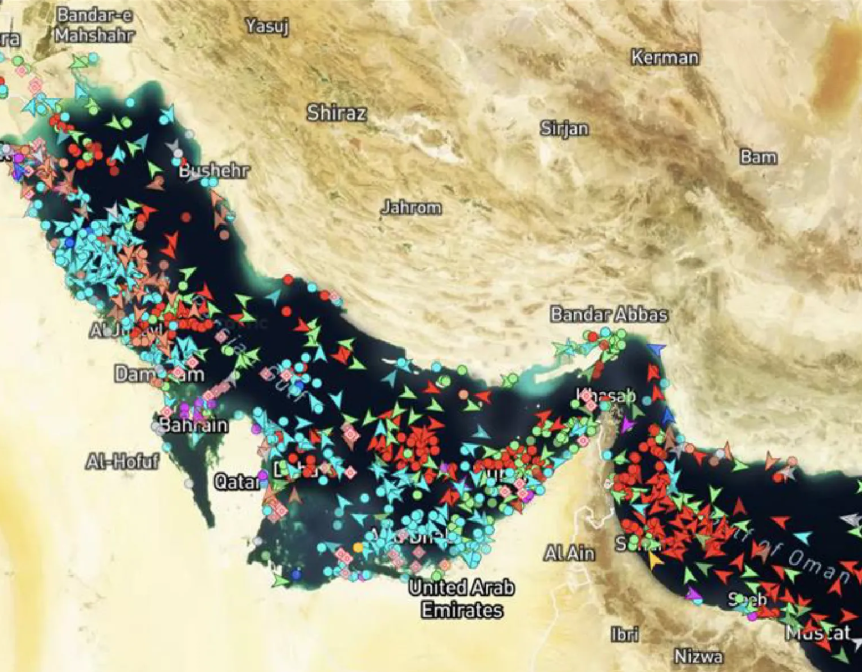
The Gulf. The Persian Gulf. Same body of water Bahrain sits in. About 20% of the world’s oil ships out through the Strait of Hormuz — the narrow stretch at the mouth of it — every single day. The same stretch that’s been blocked off since the second of March.
“I don’t.”
He shook his head once.
“They’re not calling it anything. That’s the point. There’s nothing to call it because there’s no plan to end it. The U.S. made our decision the first week. Iran made theirs. Everything since then has been the peace talks. Round after round of nothing. Just so the news has something to put on the screen.”
He paused.
“Nobody’s folding. Not the United States. Not Iran. Both sides decided early it was going to be a contest of whose people break first.”
I didn’t say anything.
He looked back out the window.
“And our people are softer than the Iranians. Iran’s been living under sanctions and shortages for forty years — they know how to do without. Americans don’t. Most of the country thinks this is going to wrap up by Christmas. It’s not.”
I kept driving.
“How long,” I asked.
He didn’t answer for a second.
“What I told my wife two weeks ago. Six to nine months before it bottoms out. Could be twelve. The bottom isn’t going to look like anything anyone in this country has seen in their lifetime.”
I let the silence sit a few seconds.
“Six to nine months. What does that look like.”
He gave me a small laugh that wasn’t a laugh.
“It already looks like something. Most people just aren’t looking.”
He turned his head toward the window.
“Cuba’s grid is gone. Hasn’t had a stable hour of power in three weeks. The whole island. Eleven million people.”
“I saw something about that.”
“You saw a headline. You didn’t see what’s actually happening on the ground. Hospitals running out of diesel. Pumping stations down. Water trucks running thirty hours behind.”
“Nigeria collapsed six days ago. The whole national grid. They called it a ‘technical issue.’ It wasn’t. Their fuel ran out. Same as Cuba. Brazil had a nationwide blackout last month — they got most of it back, but they’re rolling brownouts now and nobody’s saying when it stops.”
He paused.
“You see what those three have in common.”
“They need fuel they can’t make themselves.”
“Right. They have to buy oil from somewhere else. And the somewhere else isn’t shipping right now. Same oil that’s been stuck behind the blockade in the Strait of Hormuz since March.”
He was looking at his own reflection in the window.
“Cuba was the first canary. Nigeria was the second. Brazil’s the third. Six months ago I would’ve told you those countries weren’t us. Smaller. Less reserves. Worse-run. I was wrong about that.”
I waited.
“This isn’t picking countries by who’s rich. It’s picking by who needs that oil and can’t replace it fast enough. That’s the whole thing.”
“And the U.S.?”
He looked back at me in the rearview.
“Better off than them. Not safe.”
He shifted in his seat.
“You been keeping track of the refineries.”
“I know two are down.”
“Three. Rotterdam last week — the one you just heard about on the news. Houston the week before. A third in South Korea two days ago. Hasn’t hit the news cycle yet. They’re treating it like maintenance. It isn’t.”
“What is it.”
“Connected. Or planned. We don’t know which yet.”
I kept driving.
“What about Iran’s grid.”
“Hit twice in the last two weeks. They’re patching what they can. They can’t replace the equipment we used to ship them. Their lights are flickering. Theirs first. Ours next.”
“Australia’s rationing diesel. Did you know that.”
“No.”
“Most people don’t. They’ve started watering down their fuel to stretch it. Trucking companies told they can only buy a certain amount each week. School districts cancelling field trips for the rest of the year. The Australian government called it ‘managed scarcity.’ Want to know what ‘managed scarcity’ looks like in America in three months? Look at Australia today.”
He paused.
“The International Energy Agency called this — out loud, in Paris last week — the greatest disruption in modern history. Worse than the seventies.”
The IEA. The international group that watches every barrel of oil moving on the planet. They speak careful. They don’t say things like ‘greatest disruption in modern history’ unless they mean it.
“They don’t say things like that,” he said. “They say what they’re told to say. And they said that.”
I didn’t answer.
For another mile he didn’t say anything else.
Then:
“You know what’s going to happen here.”
“Tell me.”
“It starts soft. They’ll call them advisories. ‘Cut your power use between four and nine.’ Polite. You ignore it the first three times. By week four it’s not optional. By week six they have a name for it.”
“What name.”
“Energy lockdown. That’s what they’re going to call it. Watch for the phrase. You’ll hear it on the news in about six weeks. It’ll feel like 2020 without the masks.”
“Lockdown.”
“Lockdown. Stay home from this hour to that hour. Don’t run the AC during peak. Don’t run the dryer. Don’t charge your car. Please comply. Same playbook, different excuse. Except this one doesn’t end when somebody finds a vaccine. This one ends when oil starts flowing through the strait again.”
“And when’s that.”
“It doesn’t.”
He let that hang.
“How long do we have.”
He looked at me in the rearview.
“You’re asking the wrong question.”
“What’s the right question.”
“How long until the first major American region loses power for more than 72 hours. That’s the question.”
“How long.”
“Six to ten weeks.”
I felt my chest tighten in a way I hadn’t since I was overseas.
He kept going.
“You think this hits everybody at the same time.”
“Doesn’t it.”
He almost laughed.
“No. This hits in order. From the bottom up.”
I waited.
“The people at the top — the ones who run companies, the ones with houses in the right zip codes, the ones with friends in three different agencies — they’ve been making moves for six months. Generators. Tanks of fuel buried in the yard. Bottled water by the pallet. A second house up north or out west. Their kids are already pulled out of school. They knew before any of this hit the news.”
“By the time you and your wife see the first energy lockdown advisory on TV, they’re already past the part where it touches them. They’re insulated.”
“Then it’s working folks first. Hourly people. Truck drivers. Hospital staff. Anyone whose paycheck got tight when gas hit five dollars. Anyone whose freezer doesn’t have a backup. They run out of room first. They run out of money first.”
“Then it’s middle class. Your block. Two cars in the driveway. Thirty-year mortgage. Two kids in school. They have too much to ask for help. Not enough to buy their way out. They watch their freezer go warm in week three. They watch the savings drain. They wait for the next advisory to say it’s getting better. It never says that.”
“By the time the energy lockdown reaches the people up top, the people on the bottom have been drowning for six months. The middle has been holding their breath. And by the time the rich start to feel it, the rest of the country has already broken.”
He looked back out the window.
“That’s the part nobody’s saying out loud. Not me. Not them. Not the news. The cost of this gets paid in order. And the people who think they’ll be fine because they have a house, a job, a 401k — they’re the ones who get hit hardest. Because they think the system covers them. The system already decided who it’s going to cover. They’re not on the list.”
I thought about my wife at home. Two kids asleep upstairs. The thirty-year mortgage we’d refinanced last year. The savings that took three years of overtime to build back up after I got out.
I gripped the wheel a little tighter.
He didn’t say anything for a beat.
Then:
“Listen. The grid is the part you can prepare for. Generator. Fuel. A few weeks of food. Standard playbook. Anyone who’s been paying attention has the basics.”
“Okay.”
“There’s another part. The part nobody on the news is talking about yet.”
“What part.”
“Water.”
I waited.
“Water.”
“Water. When the grid goes down, the water goes with it. People in this country don’t think about it. Most of them have never had to. You turn the tap, water comes out. End of story.”
“But the tap doesn’t work without electricity. The pumps that push the water through the pipes — those run on power. The plants that clean the water before it gets to your kitchen — those run on power. The whole system between the river and your sink is electric. You take the power away, the system stops.”
“How fast.”
“Hours. Not days. The pumps go first. The pressure drops. Then whatever’s still in the line drains out. Then nothing comes through the tap at all.”
“That fast.”
“Texas, 2021. Three-day grid failure. Fourteen million Americans lost safe drinking water. People got sick from their own kitchen taps. Boil advisories that lasted weeks.”
“That was three days. And it was an accident. What we’re talking about isn’t three days. And it isn’t an accident.”
He let that sit.
“You can live a month without food. A week without heat. You can’t go three days without clean water. The body just doesn’t allow for it.”
“And after the pumps stop, the bottled water aisle goes in 48 hours. Anywhere they sell it. Costco goes in 72. After that there’s no more bottled water to buy. Period. You’re drinking what you stored, or you’re drinking nothing.”
“For how long.”
“Until the grid comes back. Could be days. Could be weeks. Could be a lot longer than that.”
I didn’t know what to say.
He looked back at me in the rearview.
“Of all the things people are about to run out of, water is the one nobody on the news is talking about. The shelves on every other aisle empty out gradually. People notice. People plan. People drive to the next county. The water aisle goes in two days with no warning. And it doesn’t come back.”
He looked back out the window.
“That’s the part I can’t sleep about. Not the lockdowns. Not the gas. Not the freezer going warm in week three. The water. The five-year-old in some kitchen on day four with no clean water to give her. That’s the part.”
I let his last words sit. The five-year-old in some kitchen on day four.
I didn’t say anything for a long minute.
Then:
“What do you do for water.”
He looked at me in the rearview but didn’t answer.
“Sir.”
“Yeah.”
“What do you do for water.”
He looked back at the window.
“I’ve got my way.”
“What’s the way.”
“Not something I share.”
“Sir. With respect. You just spent forty minutes telling me my kids might not have water in two months. You can’t tell me that and then tell me you can’t tell me how you handle it.”
He almost smiled but didn’t quite.
He didn’t say anything for a long second.
Then:
“You’re right. I can’t.”
He shifted in his seat. Looked at his briefcase. Looked back out the window.
“It’s not a secret exactly. It’s just not something I share around. There are reasons.”
“Like what.”
“Like the second this gets out, the same thing happens that happens with every other shortage. People panic. The supply runs out. The guys who’ve been quietly doing what they’re supposed to be doing for their families end up in the same line as everyone else.”
“So it’s a real thing.”
“It’s a real thing.”
“You have one.”
“I have one with me right now.”
I kept driving.
“You going to show me.”
He looked at me again in the rearview. Longer this time.
“Yeah.”
He turned slightly. Reached down beside his seat. Pulled up his briefcase and set it across his knees.
He didn’t open it.
He just sat with it across his lap for a few seconds.
Then he reached into the side pocket.
What he pulled out wasn’t what I expected.
It was a water bottle. Stainless steel. Dented along one side. Looked like it had been with him a long time.
He unscrewed the cap.
Then he tipped the bottle and took a long drink.
When he finished he turned the bottle so I could see the top of it in the rearview mirror.
There was a small filter screwed onto the cap.
Smaller than my thumb. Plain. Looked like a piece of nothing.
“This.”
“That.”
“This is what I keep on me. Every guy in my circle has one. The colonel I flew back with from overseas had one in his bag. My boss has six in his garage — he ordered them in January, before any of this was in the news. I have one in my briefcase right now. Two in my carry-on. Four at the house.”
“What does it do.”
“Pulls clean drinking water out of anything fresh. Stream. Pond. Rain barrel. Whatever’s in your bathtub if you filled it before the pumps went down. Toilet tank if it comes to that. Screws right onto the top of any water bottle. Takes the bacteria out. Takes the parasites out. Takes the stuff that puts you in the hospital out. What comes through the bottom is clean.”
“What about power.”
“None. No batteries. No charging. No nothing. Doesn’t need a single thing from the grid. Which is the whole point. When the grid goes, it still works. When the bottled water aisle goes, it still works. When the trucks aren’t moving anymore, it still works.”
“How long does it last.”
“Four hundred gallons per filter. That’s a year of drinking water for one person. Real water. Not boiled. Not waited for. Just clean water out of whatever you can get to.”
I looked at the filter again in the rearview.
“What’s in your bottle right now.”
He almost smiled at that.
“Tap water from the bathroom sink at the international terminal in Doha. Filled it three hours ago before I got on the plane. I wouldn’t drink that water without this thing. With it I drink it on every trip. Hasn’t put me down in two years.”
He capped the bottle and set it back beside him.
“Most of the guys in my world started buying these last year. Quietly. The ones who knew what was building. By the time the rest of the country figures out the water aisle is empty, those guys’ families are fine.”
He looked at me through the gap between the seats.
“Listen to me. Everything else I said tonight — the lockdown timeline. The bottom-up thing. The six-to-ten weeks. People can argue with me about it. Some of it might be wrong. Most of it isn’t. But you can take it or leave it. You can decide I’m exaggerating. You can decide your block isn’t going to be the first one hit. You can be wrong about that and you’ll figure it out as it comes.”
“What you cannot do is be wrong about the water. There’s no figuring it out as it comes. The water either works or it doesn’t. The day you find out it doesn’t is the day you needed to have already done something about it.”
“So you can forget everything else if you want to. Forget the cash. Forget the generator. Forget the food. Forget the standoff. Forget I said any of it.”
“You can’t forget the water.”
We made the right turn off the parkway and into McLean.
The neighborhood looked like every other neighborhood in this part of the world. Old trees. Big lots. Houses set back. The kind of street where you can’t see the windows of the next house from the windows of the one you’re in.
He didn’t say anything for the last two minutes.
I pulled up to the address. White colonial. Long driveway. One light on by the front door.
He didn’t move to get out.
He looked down at his phone. Pulled up something on the screen. Then he held it forward between the front seats so I could see.
It was a website. One product. The same little filter I’d seen on his water bottle.
“This is where I get them,” he said. “This is where the colonel got his. This is where my boss got his six in January. Not Amazon. Not Walmart. Not any store. Just here.”
“You have kids.”
“Two. Boy seven, girl four.”
“Get one for each of them. Get one for your wife. Get one for yourself. Get a couple extra. Don’t think about it. Don’t read reviews. Don’t ask your wife what she thinks. Just buy them. Before you go to bed tonight.”
“Why tonight.”
“Because tomorrow morning the news is going to run something. And by tomorrow night a few thousand more people are going to figure out what we just talked about. And by next week the website’s going to be telling people they’re out of stock until further notice. The math isn’t on your side.”
He pulled his phone back. Sent something. My phone buzzed in the cup holder.
He’d sent me the link.
He picked up his briefcase. Reached for the door handle.
Then he stopped.
He turned and looked at me through the gap between the front seats.
“You know who’s not going to make it through this. Guys like me. People in my zip code. Friends of mine I went to grad school with. People who think their job and their savings cover them.”
“Their water is going to stop too. Same as everyone else. The difference is they had warning. Every single one of them had warning. Some of them listened. Most of them didn’t. The ones who didn’t are who I think about at 2 in the morning.”
“Don’t be one of them.”
He opened the door.
“Thank you for the ride.”
“Yes sir.”
He shut the door and walked up the driveway.
I sat there for a second. Looked down at my phone. The text he’d sent had one link in it. Nothing else.
I closed the phone.
I drove home the back way. Thirty minutes. Didn’t turn the radio back on.
Let myself in just after eleven. Took my boots off in the hallway. The house was quiet.
My wife was asleep on the couch with the TV still on. Kids upstairs.
I sat at the kitchen table for a while. Pulled the link up on my phone. Looked at it. Considered tapping it.
Didn’t.
I closed the phone.
I told myself the man in my back seat had been overseas for a week, hadn’t slept, and had had a phone call that didn’t go his way before I picked him up. Stressed government people tell you all kinds of things they don’t believe two days later. I’d heard a version of it overseas a couple of times.
I went to bed.
Two days passed and I didn’t buy anything.
Didn’t tell my wife about the ride. Didn’t want to scare her over what might’ve been a tired guy venting in the back of an Uber.
Then on Friday morning, walking the kids to school, my wife stopped in the middle of the sidewalk and showed me her phone. California had issued a brownout advisory the night before. “Voluntary reduction in non-essential power use between 4 and 9 PM.”
The exact phrase he’d told me would be the first one. Five and a half weeks ahead of when he said it would happen.
I didn’t say anything to her. Walked the kids the rest of the way to school. Came home. Sat at the kitchen table.
Then on Sunday afternoon I was making coffee and a CNBC anchor on the kitchen TV used the words “energy lockdown.” Not in a headline. In the actual segment. He said “we may be facing a months-long energy lockdown.”
Word for word what the man in my back seat told me to watch for.
I sat down with my coffee for a long time after that.
That night I shook my wife awake at eleven and told her what happened.
Word for word, the way I used to take notes after a brief.
Cuba grid down three weeks. Nigeria collapsed six days ago. Brazil rolling brownouts. Three refineries on three continents offline. Iran’s grid hit twice in two weeks. Australia rationing diesel and watering down their fuel. International Energy Agency calling this the worst in modern history. Energy lockdown coming. Six to ten weeks until the first major American region loses power for 72 hours. Water goes when the grid goes, in hours not days. Bottled water aisle goes in 48 hours, no warning, no restock.
I told her about the filter. About the colonel. About the boss who bought six in January.
She listened to the whole thing without saying anything.
When I was done she went into the bathroom. I could hear her brushing her teeth.
She came back out and asked one question.
“Where’s the link.”
I showed her.
She bought ten.
The shipment arrived four days later.
I unpacked them on the kitchen table. Five filters, plus five more on the way to extended family. My wife’s mom. Her sister. My brother in Ohio. A buddy of mine still in service.
I picked one up and walked out the back door.
There’s a creek behind our subdivision. Runs along the edge of the wooded lot at the back of our property. Muddy. Leaves in it. Nobody who lives here drinks out of it. Nobody would.
I knelt at the edge.
Filled my water bottle straight from the creek. The water that came up looked like weak tea. Bits of leaf in it. A small bug I had to flick off the rim.
Screwed the filter onto the cap.
Stood up.
Drank.
It tasted like water. Regular water. Like what comes out of the tap on a normal day. Cold because the creek was cold. No grit. No taste. Nothing.
I pulled the bottle away and looked at it.
The water inside the bottle was still brown.
But what came through the filter was clear.
I stood there at the edge of the creek for a long time after that.
Then I went home and ordered five more.
I don’t know who’s reading this. I don’t know what you do for a living. I don’t know if you’re like the people the man in my back seat was talking about — the ones who think they’ll be fine because they have a house and a job and a savings account.
I’ll tell you what I tell my Marine guys when they ask me for advice on something they haven’t seen before.
The system didn’t tell us about the gas prices climbing. The system didn’t tell us about the peace talks failing seven times in two months. The system isn’t going to tell us about the water until it’s too late to do anything about it.
The man in my back seat is paid to know things before the rest of us do. He didn’t have to tell me anything. He could have ridden home in silence and tipped 30% and been done with it. He didn’t. He told me. Because he has a wife and two daughters and he could hear from one sentence that I have the same.
I sat on what he said for two days. I told myself he was just stressed. I was wrong about that.
The people who know are quietly buying these now. Before the rest of the country figures out why.
This is the link. The same one he sent me. The same one his colonel uses. The same one his boss bought six of in January.
https://primitivelabsresearch.com/…/hydra-x1-portable…
When the energy lockdown hits and the water stops and the bottled aisle goes empty in 48 hours, you want to be the person who already has these in the kitchen drawer. Not the one driving from Costco to Costco trying to find them.
EDITED: Two more things have happened since I posted this. A refinery in Long Beach went offline yesterday. The article called it “scheduled maintenance.” That’s the fourth in two months. And my mother-in-law in Tampa went to her local Costco yesterday and they were rationing bottled water — two cases per family. She’d never seen that in her life.
EDITED AGAIN: A woman in the next town over messaged me Sunday. Her husband works at a regional power authority. He pulled their family up to her parents’ place in Pennsylvania this past weekend. He said he wasn’t comfortable having his kids in this part of the country for the next ten weeks. They didn’t tell anyone they were leaving. They just left. I think about that every day.
I haven’t seen the man in my back seat since. He hasn’t booked another premium ride out of Reagan that’s come to me. He might be flying again. He might not be. I don’t know.
What I know is the messages haven’t stopped since I posted this. Marines I served with. Two guys from my old logistics unit. A neighbor down the street who saw it on Facebook. They’ve all been asking the same thing. Where do I get these. Are you sure. Is this real.
It’s real. I’m sure. Get them.
P.S. — My wife pointed out something I didn’t think about until she said it. The man in my back seat has one in his briefcase. His wife has one in her purse. His colonel has a set in the car. His boss bought six in January. None of those people are people who panic. They are calm, quiet, well-paid, well-informed adults who do the math first and then move quietly. If all of them are moving on this, the math has already been done. The question is whether you do it before the rest of the country does, or after.
P.P.S. — Each filter does 400 gallons of clean drinking water. That’s a full year for one person, taken from any creek, pond, rain barrel, river, or whatever’s left in your bathtub after you filled it before the pumps went down. No batteries. No power. No refills. Lifetime warranty. 60-day money back if it doesn’t do what they say it does. Free shipping. If you only have the money for one thing, get the filter. You can survive being cold. You can survive being in the dark. You cannot survive three days without clean water.
P.P.P.S. — If you’re thinking you’ll just stockpile bottled water instead, do the math with me. A case of water is 24 bottles. Each bottle is 16 ounces. That’s three gallons of water in a case. A family of four needs at least one gallon of clean water per person per day. So one case is less than a day for a family of four. To last six weeks — the timeline he gave me before the first major region goes dark — a family of four needs about 56 cases. That’s two pallets in your garage. The filter is the size of a marker. It does the work of 130 cases of water. That isn’t a comparison. That’s just math.
P.P.P.P.S. — When my wife ordered, she added the brand’s emergency bivvy and their solar kit too. After what he told me about the energy lockdown going on for months and the AC being off in summer, she wanted backups for the kids. But if you only get one thing, get the filter. Don’t think about it. Just get it.